Mysteries of the Sistine Chapel. While that ceiling is undeniably extraordinary, the chapel itself is far more complex than many visitors expect. It is not simply a room containing a masterpiece. It is a place where art, theology, ritual, politics, symbolism, and history are woven together with remarkable intensity. To step inside is to enter a space designed not only to impress the eye, but to shape the mind and stir the imagination.
For many travelers, the first reaction is silence. Even in the presence of crowds, the Sistine Chapel carries a weight that goes beyond beauty alone. The scale of the frescoes, the richness of detail, and the atmosphere of sacred significance combine to create an experience that feels almost overwhelming. Every surface seems to speak. Every figure appears to participate in a larger story. Looking up, one quickly realizes that this is not decoration in the ordinary sense. It is a vision of creation, humanity, judgment, and divine order, expressed through one of the most ambitious artistic programs ever attempted.
What makes the chapel so fascinating is that it reveals something new each time it is studied. It can be admired as a triumph of Renaissance art, read as a complex theological text, or explored as a political statement at the heart of the Vatican. Its mysteries are not hidden because they are inaccessible, but because the chapel was created with layers of meaning. The more carefully one looks, the more those layers begin to emerge.
The Hidden Mysteries of the Sistine Chapel
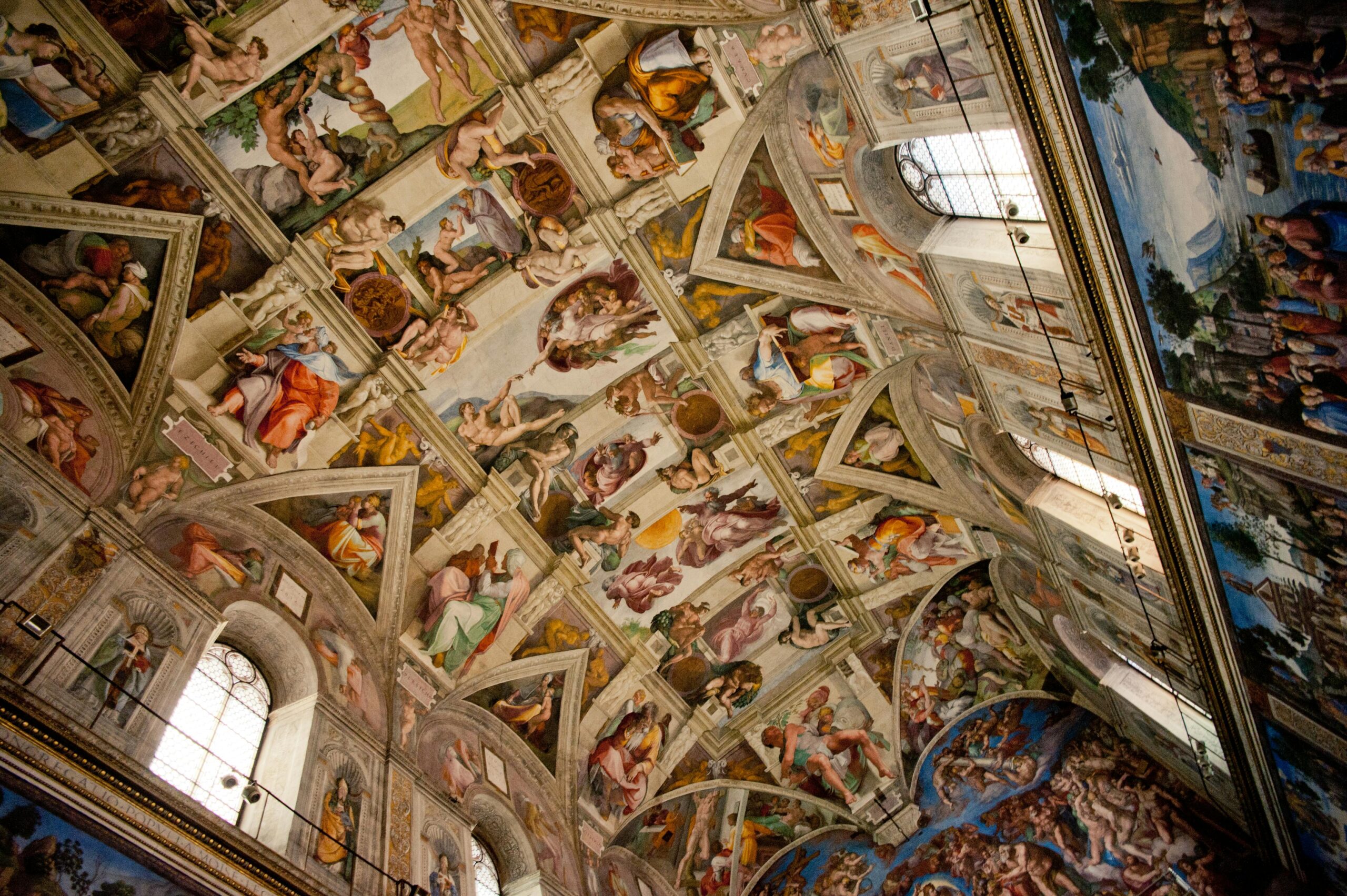
The first mystery lies in the way the ceiling tells its story. Many visitors know the central image of the Creation of Adam, where the nearly touching hands of God and man have become one of the most famous visual symbols in art history. Yet this iconic detail is only one moment in a vast narrative. Across the ceiling, scenes from the Book of Genesis unfold in a carefully structured sequence, moving from the creation of the world to the fall of humanity and the story of Noah. These episodes are surrounded by prophets, sibyls, ancestors, and ignudi, all arranged in a program that is both visually dazzling and intellectually demanding.
The inclusion of the sibyls is especially intriguing. These female prophetic figures from the classical world appear alongside Old Testament prophets, suggesting a broader vision of revelation that reaches beyond a single tradition. Their presence reflects the Renaissance fascination with harmonizing Christian belief and ancient knowledge. In this sense, the Sistine Chapel becomes more than a religious monument. It becomes a statement about wisdom itself, gathering voices from different histories into one unified vision. This blending of sacred and classical elements is one reason the chapel continues to inspire debate and interpretation.
The figures themselves also contribute to the sense of mystery. Michelangelo’s bodies are powerful, expressive, and charged with emotional tension. They seem carved from paint, shaped with sculptural force. This physical intensity is not merely stylistic. It reflects a vision of humanity as noble, tragic, and deeply bound to spiritual drama. Even when still, the figures feel full of potential movement. They create a world in which the body is not secondary to meaning, but one of its main carriers. Through posture, gesture, and expression, the ceiling communicates ideas that words alone could never fully capture.
Then there is the chapel wall with The Last Judgment, added later by Michelangelo above the altar. If the ceiling invites meditation on beginnings, this vast fresco confronts viewers with endings. Here the tone shifts dramatically. The ordered clarity of Genesis gives way to turbulence, motion, and reckoning. Saints, angels, martyrs, and the resurrected rise and fall in a vision that is both terrifying and mesmerizing. At the center stands Christ, not as a gentle infant or suffering victim, but as a commanding judge whose gesture sets the entire cosmos in motion. This work transforms the chapel from a story of creation into a complete meditation on human destiny.
Why the Sistine Chapel Is More Than an Artistic Masterpiece
The chapel’s significance also comes from its living function. It is not simply a historic room preserved for admiration. It remains one of the most important ceremonial spaces in the Catholic world. Most famously, it is the site of the Conclave, where cardinals gather to elect a new pope. This fact adds another layer of meaning to the frescoes surrounding the space. The art is not separate from the life of the Church. It forms the visual and spiritual setting for some of its most solemn decisions. In this way, the Sistine Chapel is both museum and sacred institution, both artwork and active place of history.
The architecture of the space contributes to its power as well. Though the chapel is not vast in the way some first-time visitors imagine, its proportions and enclosed atmosphere create a striking sense of concentration. Unlike a grand open piazza or soaring basilica, this is a more contained environment. That containment intensifies the effect of the imagery. The viewer is surrounded, almost enclosed within a total work of art. The frescoes are not encountered casually; they insist on attention. The chapel becomes a world unto itself, where painting, ritual, and silence interact.
Another enduring mystery lies in the personality of Michelangelo himself. He considered himself primarily a sculptor, yet he produced one of the most famous painted ceilings in history. He worked under immense pressure, faced technical challenges, and created a result that changed Western art forever. Scholars have long studied hidden meanings in his imagery, from theological symbolism to anatomical references and personal expression. Whether every theory is convincing or not, the very existence of such debates proves how rich the chapel remains as an object of interpretation. It continues to resist a single fixed explanation.
The Sistine Chapel is also inseparable from the broader legacy of the Renaissance. It embodies the confidence, ambition, and intellectual depth of a period that believed art could reveal profound truths about humanity and the divine. The chapel stands at the meeting point of faith and humanism, sacred tradition and artistic innovation. It reflects a culture that saw no contradiction in using beauty, proportion, and classical ideals to express Christian mystery. That synthesis gives the space much of its enduring power.
Visitors who enter through the Vatikanens museer often arrive expecting a climax, and in one sense that expectation is justified. But the real surprise is how much the chapel offers beyond visual fame. It is a place of questions as much as answers. Why are certain figures placed where they are? How do prophecy, creation, and judgment connect? Why does the emotional force of the paintings still feel so immediate centuries later? These are part of what makes the experience unforgettable. The chapel does not simply display greatness. It invites contemplation.
Even details that might seem familiar can become mysterious when seen in person. The famous Creation of Adam, for example, is often reproduced so widely that it risks becoming ordinary in memory. Yet on the actual ceiling, surrounded by the full narrative and architectural framework, it regains its depth. It is no longer just an isolated image, but part of a larger meditation on life, dependence, and divine energy. The same is true of the prophetic figures, the altar wall, and the surrounding decoration by artists such as Botticelli och Perugino, whose contributions are sometimes overshadowed but remain essential to the chapel’s identity.
To understand the Sistine Chapel fully, one must see it as more than a ceiling and more than even a single artist’s triumph. It is a layered space where theology becomes image, ritual becomes memory, and beauty becomes a form of thought. Its mysteries remain alive because the chapel was never meant to be exhausted at a glance. It asks for time, patience, and humility. In return, it offers not just spectacle, but one of the deepest and most moving encounters in the history of art. That is why the Sistine Chapel continues to fascinate the world: not only because it is beautiful, but because it is endlessly meaningful.

 English
  Polski
  Español
  Português
  Deutsch
  Français
  Italiano
  Português do Brasil
  Čeština
  Dansk
Dansk  Ελληνικά
  한국어
한국어  日本語
日本語  简体中文
简体中文  Русский
  Svenska
  Nederlands