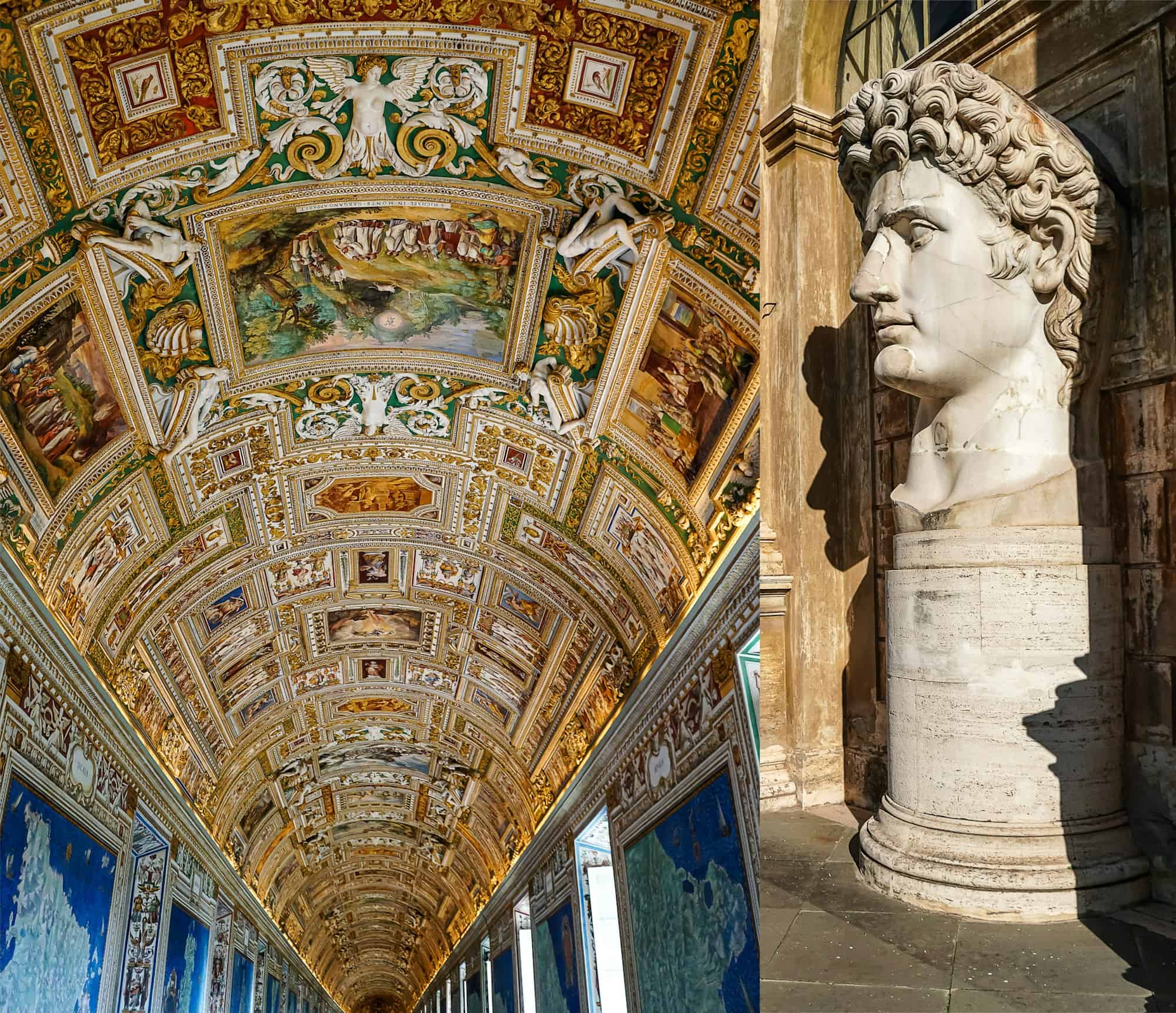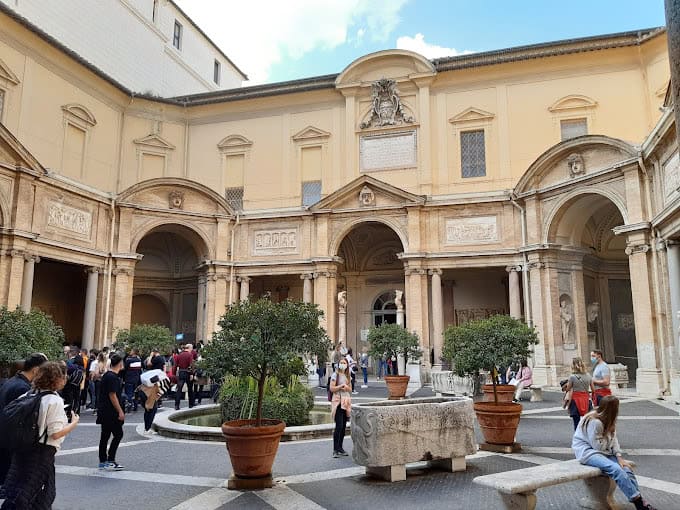
De Achthoekige binnenplaats, located in the Vaticaanse Musea, is one of the most iconic spaces in the complex. Originally designed by the Renaissance architect Donato Bramante in the early 16th century, this courtyard is a stunning open-air gallery that houses some of the Vatican’s most important classical sculptures. The layout of the courtyard, with its eight sides, provides an elegant backdrop to masterpieces such as the Laocoön Group and the Apollo Belvedere. These ancient statues are displayed in niches that allow visitors to admire their beauty and historical significance from all angles. The Octagonal Courtyard is not only a place of artistic importance but also offers a peaceful atmosphere, perfect for reflecting on the masterpieces of antiquity that have shaped Western art.

Octagonal Courtyard sculpture highlights
Useful information
Opening hours:
- Monday – Saturday: 9:00 AM to 6:00 PM (last entry at 4:00 PM).
- Last Sunday of the month: free entry from 9:00 AM to 2:00 PM (last entry at 12:30 PM).
- Closed days: Sundays (except the last Sunday of the month) and certain religious holidays such as Christmas and Easter.
Tickets:
- It is advisable to purchase tickets online in advance to avoid long lines.
- Tickets can be booked with timed entry to reduce waiting times.
- Discounts are available for children, students, and groups.
- Audioguides and guided tours are available in various languages.
How to get there
History
De Octagonal Court (Cortile Ottagono) was once known as the Cortile delle Statue, and it housed the first nucleus of antique classical statues in the pontifical collections. The Vatican Museums explain that Pope Julius II (1503–1513) displayed an extraordinary collection of antique sculpture here, with the ambition of reviving the “Rome of the Caesars” within the Rome of the Popes.
In the late 1700s, the Vatican notes that Clement XIV en Pius VI transformed the growing collection into a purpose-built museum, and the court became the fulcrum of that new project. This period is also when the Pio Clementino Museum takes its name, honoring the two popes who oversaw its foundation.
Despite later changes over the centuries, the Vatican Museums state that some sculptures—specifically including the Laocoön and the Apollo Belvedere—remain in positions they have held since the early 16th century. For today’s visitor, that continuity is part of the magic: you’re not just seeing famous works, you’re standing in a historical display environment that helped shape how Renaissance and later artists learned to look at antiquity.
De Octagonal Court (Cortile Ottagono) was once known as the Cortile delle Statue, and it housed the first nucleus of antique classical statues in the pontifical collections. The Vatican Museums explain that Pope Julius II (1503–1513) displayed an extraordinary collection of antique sculpture here, with the ambition of reviving the “Rome of the Caesars” within the Rome of the Popes.
In the late 1700s, the Vatican notes that Clement XIV en Pius VI transformed the growing collection into a purpose-built museum, and the court became the fulcrum of that new project. This period is also when the Pio Clementino Museum takes its name, honoring the two popes who oversaw its foundation.
Despite later changes over the centuries, the Vatican Museums state that some sculptures—specifically including the Laocoön and the Apollo Belvedere—remain in positions they have held since the early 16th century. For today’s visitor, that continuity is part of the magic: you’re not just seeing famous works, you’re standing in a historical display environment that helped shape how Renaissance and later artists learned to look at antiquity.
Reviews
A Peaceful Gem Amidst the Crowds – Emily J.
A Stunning Collection of Ancient Sculptures – David R.
Historical Masterpieces in a Perfect Setting – Laura M.
Tips
Do a two-pass courtyard loop. The Octagonal Courtyard is small enough to repeat without “wasting time,” and repeating is the trick. First pass: keep moving and identify your priority statues and the best viewing angles. Second pass: slow down and circle one work properly. Sculpture is designed for movement, so the second pass often reveals details you literally cannot see from your first position. Even if the room is busy, this method works because it gives you a reason to return once the flow shifts.
Use a no-photo minute to see the real drama. Photos flatten sculpture. Give yourself one minute with your phone away in front of your chosen statue. Look at the silhouette first, then step closer and notice where the surface changes, tension in a hand, a twist in the torso, or the way drapery creates rhythm. Once you’ve seen it with your eyes, take one or two photos as a souvenir. This simple habit makes your memory clearer and stops the courtyard from becoming just another image on your camera roll.
Arrive light and arrive early. The Vatican’s security and dress-code rules are real, and the museum is long. If you arrive flustered, you’ll speed-walk through the courtyard and miss what makes it special. Bring a small bag, keep essentials minimal, and build buffer time so you enter calm. The Octagonal Courtyard is positioned early on the route, which is perfect, if you don’t burn your energy before you even start. Your goal is simple: reach the courtyard with attention still available.
Step aside instead of fighting the crowd. In busy moments, the worst feeling is trying to stop in a corridor of people. Don’t fight it. Let groups pass, then return to your statue when you have even a small pocket of space. The courtyard rewards short, calm pauses more than long, stressful ones. This tactic also improves your viewing angles: you’ll naturally end up in less crowded spots, where the statue reads more clearly and you can actually circle without feeling like you’re blocking anyone.